Peer-To-Peer Crypto Exchanges: Here’s Everything You Need to Know

Press Release • October 24, 2022

The term “peer-to-peer crypto exchange” may sound weird to those unfamiliar with crypto. Many newcomers are unclear about what it means and how it differs from other cryptocurrency exchanges.

This short guide will help you learn more about P2P crypto exchanges:

  • How they operate.
  • What makes them better than centralized crypto exchanges.
  • What the future possibly holds for them.


What Is a Peer-To-Peer Crypto Exchange?

A peer-to-peer (P2P) crypto exchange lets users trade cryptocurrencies with one another without the influence of a middleman, such as banks or other regulatory bodies.


P2P crypto exchanges often have considerably more liberal standards than traditional centralized exchanges, which typically have tight rules and require users to verify before accessing and utilizing the platform.


When using a P2P crypto exchange, you can choose your preferred offer and conduct business with a counterpart directly instead of using an automated process to carry out your transactions. It gives you the ability to choose the most affordable rate and payment option for your needs. Additionally, direct contact with a counterpart allows you to protect your privacy better.


P2P crypto exchanges are also favored over traditional ones because they usually don’t have a single point of failure. Digital assets are not stored on the exchange; each trader owns them separately. The platform serves only to facilitate the transaction.


How Does a P2P Crypto Exchange Work?

P2P exchanges facilitate crypto trades by connecting buyers and sellers. The platform will typically charge a small fee for each trade made, and users will be required to store their funds in a separate digital wallet managed by the platform.


You will only need to provide an email address and a password when signing up for a P2P crypto exchange. Furthermore, most of the time, you will not be required to provide any ID verification to use a P2P crypto exchange.


On the platform, various buy and sell offers for Bitcoin (BTC), and other cryptocurrencies appear. Each seller will have a different interest rate, payment method, and maximum or minimum purchase amount. It’s up to you to determine what works best for you.


Some P2P platforms require participants in a trade to submit collateral to an escrow contract, which will be released once the transaction is completed. If there’s a conflict, the collateral will be used to compensate the affected party. Other P2P exchanges only require the seller to send collateral, which they will receive back once the buyer confirms the transaction.


P2P platforms are often likened to online markets like Craigslist or Facebook Marketplace because they connect crypto buyers and sellers. However, on those platforms, it isn’t easy to establish trust. You can’t be certain that a buyer will pay for crypto after receiving it. Most P2P exchanges employ a feedback or rating system to solve the issue of trust. This system allows participants in a transaction to confirm each other’s track records and reviews before completing the transaction.


Advantages of P2P Crypto Exchanges

Reduced Fees

P2P crypto exchanges charge a transaction fee for all trades. But since transactions on these platforms have no intermediaries, they only charge escrow fees, making them significantly less expensive than centralized exchanges.


Security

P2P platforms frequently employ security features such as encryption and two-factor authentication to protect users. As a result, users can be assured that their funds are secure when transacting on these networks.


Additionally, the escrow system protects all parties involved in a transaction, including the exchange itself. Users don’t have to worry about losing their crypto because they’re not stored on the platform.


Various Payment Options

Since P2P exchanges link buyers and sellers, they can offer various payment options. These include conventional payment methods like fiat cash, credit cards, PayPal, and virtual currencies such as BTC, Ether (ETH), and Litecoin (LTC).


Accessibility

You only need a smartphone and access to the internet to send and receive crypto on a P2P exchange. Also anyone can use these platforms regardless of their location.This is due to the lack of centralized authority, governments with strict crypto regulations cannot shut them down.


Demerits of P2P Crypto Exchanges

Slow Transaction Speeds

Trading speeds can be quite slow on P2P exchanges. The lack of an intermediary and inability to streamline the selection of payment methods, which means each transaction takes longer.


Furthermore, a participant may postpone a transaction, causing delays and frustration when attempting to purchase or sell cryptocurrency. Such delays may even impact your bottom line if the crypto’s price moves in the meantime.


Low Liquidity

The liquidity of P2P platforms is typically lower than that of centralized exchanges. As a result, somebody might not always be available to process your trade order.


What Next for P2P Crypto Exchanges?

P2P crypto exchanges are better for those who do not want to lose custody of their digital assets and prefer to handle transactions themselves. These platforms, while more time-consuming, are far more secure than centralized exchanges.


Platforms like Binance P2P, Paxful, and Bybit are considered some of the best-decentralized exchanges, with all the features needed to facilitate a quick and seamless crypto trade.


However, the crypto space is constantly evolving, so there’s a need to move the P2P concept to the next level to keep up with technology and market demands.


Encouragingly, newer P2P platforms like Payslink seem to be doing just that. Payslink is leveraging blockchain technology, including self-executing smart contracts, to improve the transparency, security, and transactional speed of P2P crypto exchanges.


Conclusion

Low liquidity and slow transaction speeds are obvious black marks on P2P exchanges, as are the occasional poorly designed user interfaces, which make some of them hard to navigate.


But despite this, P2P platforms aren’t going anywhere anytime soon. Their usefulness far outweighs their disadvantages, especially concerning cost, accessibility, security, and flexibility.


There are hundreds of P2P crypto exchanges, each with pros and cons. Therefore, before deciding to use one for your transactions, you should do as much research on them as possible.


Disclaimer: This article is not intended to be a source of investment, financial, technical, tax, or legal advice. All of this content is for informational purposes only. Readers should do their own research. The Capital is not responsible, directly or indirectly, for any damage or loss caused or alleged to be caused by reliance on any information mentioned in this article.

Disclaimer: This article is not intended to be a source of investment, financial, technical, tax, or legal advice. All of this content is for informational purposes only. Readers should do their own research. The Capital is not responsible, directly or indirectly, for any damage or loss caused or alleged to be caused by reliance on any information mentioned in this article.

Disclaimer: This is not trading or investment advice. The above article is for entertainment and education purposes only. None of the content on Crypto Folds is investment advice nor is it a replacement for advice from a certified financial planner. Please do your own research before purchasing or investing into any cryptocurrency.  
By Press Release December 12, 2025
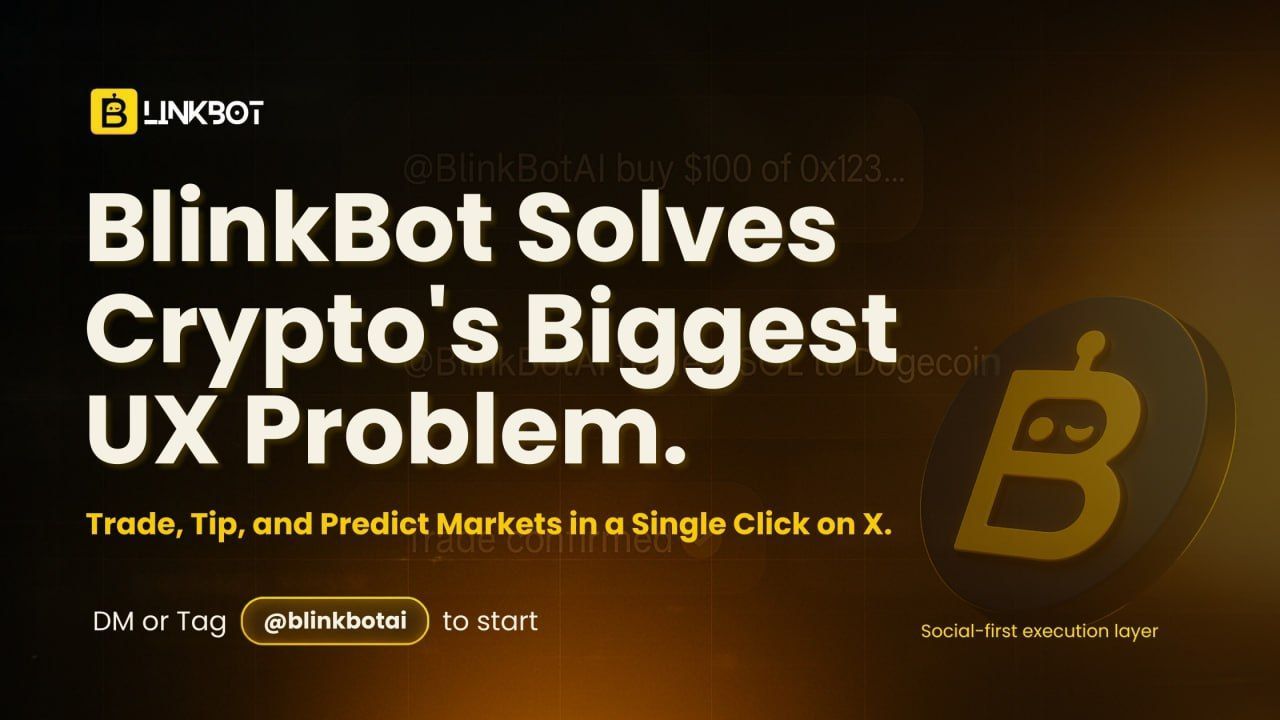
BlinkBot is a new AI-powered trading and transaction assistant on X.com. It removes the friction from on-chain crypto actions, allowing users to manage their portfolios, trade, swap tokens, tip creators and place prediction market bets simply by typing commands directly into a reply or DM.  Actions that once required complex, multi-step processes like opening wallets, switching apps, copying addresses are now compressed into a single, intuitive interaction layer within X. For example: Set up a wallet: Type @blinkbotai Balance Trade: Type @blinkbotai buy $100 worth of ETH Token Generation Event & Airdrop Details The $BLINK token is coming on December 16th. The $BLINK token is launching with a pioneering Salutory governance model, designed to deliver unprecedented value and control. This new structure emphasizes Control , establishing a legally enforceable path for the company's acquisition solely through the token . This unique mechanism protects token holders by embedding direct ownership and transparency into the token itself, making the $BLINK token the definitive path to corporate control." We are committed to rewarding real users, not bots. The size of your airdrop allocation will be tied to your Proof of Usage , measuring actual engagement with the BlinkBot ecosystem. How to qualify: Engage with the platform by setting up a wallet, executing a trade, tipping a creator, and more. Key Capabilities: Built for Social, Designed for Usage BlinkBot is built for the everyday crypto user who is already tracking markets and narratives on X. Instead of redirecting users externally, BlinkBot brings the market to the conversation. Live Features Include: Multichain Token Trading: Trade supported tokens across major networks including Solana, Ethereum, Base, and BNB Chain directly from posts or private messages. Creator Tipping: Send value to creators instantly without complex wallet flows or browser redirects. Polymarket Integration: Place prediction market bets directly through BlinkBot, enabling fast access to real-world event markets without leaving X. Flexible Trading Modes: Execute trades transparently in public threads or privately via DMs. Wallet & Portfolio Dashboard: View balances and track multi-chain portfolios through the dedicated web interface. BlinkBot is designed for speed, allowing users to execute a trade or open a position the moment an opportunity is perceived, eliminating the lag between intent and execution. Trading via Contract Addresses (Live) & Ticker Trading (Upcoming) At present, BlinkBot supports trading only through Contract Address (CA) input. This ensures accuracy and helps users avoid mistakes that can occur when multiple tokens share the same ticker symbol. To protect users from potential fund loss caused by duplicate or misleading tickers, direct ticker-based trading will be introduced through a controlled whitelist system. Only verified projects will be enabled for ticker trading. This approach balances ease of use with user safety while gradually expanding ticker-based functionality. Multichain Execution BlinkBot is built as a chain-agnostic execution layer. This design allows users to interact across multiple ecosystems ( Ethereum, Solana, BNB Chain, and Base ) through a single command flow, moving between chains without the need to switch wallets or platforms. Polymarket Access Through Social Interaction BlinkBot’s integration with Polymarket allows users to interact with prediction markets exactly where information spreads fastest. Users can browse active markets, place positions directly from X, and react to real-time events with immediate execution. By embedding prediction markets inside social feeds, BlinkBot bridges the gap between news, sentiment, and on-chain action. Wallet Manager & Control The dedicated Wallet Manager and Portfolio Tracker provide a central hub to view and manage assets. Through the Wallet Manager, users can: View all connected wallets. Track balances across supported chains. Monitor portfolio activity. Manage execution access centrally. Access the Wallet Manager here: https://login.useblink.bot/ Availability and Next Steps BlinkBot is currently live with core trading, tipping, wallet management, multichain support, and Polymarket prediction market features. The team is actively developing additional functionality, including ticker-based buys, smart contract deployment, and a browser extension. The goal is to establish BlinkBot as the single unified execution layer across the most active on-chain ecosystems. Join the Waitlist & Ecosystem Today: Follow @teamblinkbot on X to stay updated. Initialize Your Wallet: Reply to any post (or send a DM) with the command: @blinkbotai balance (This automatically generates your secure BlinkBot wallet address.) Verify: Join our Discord for updates and verification: https://discord.gg/jVw5gNfdV6
By Press Release December 10, 2025
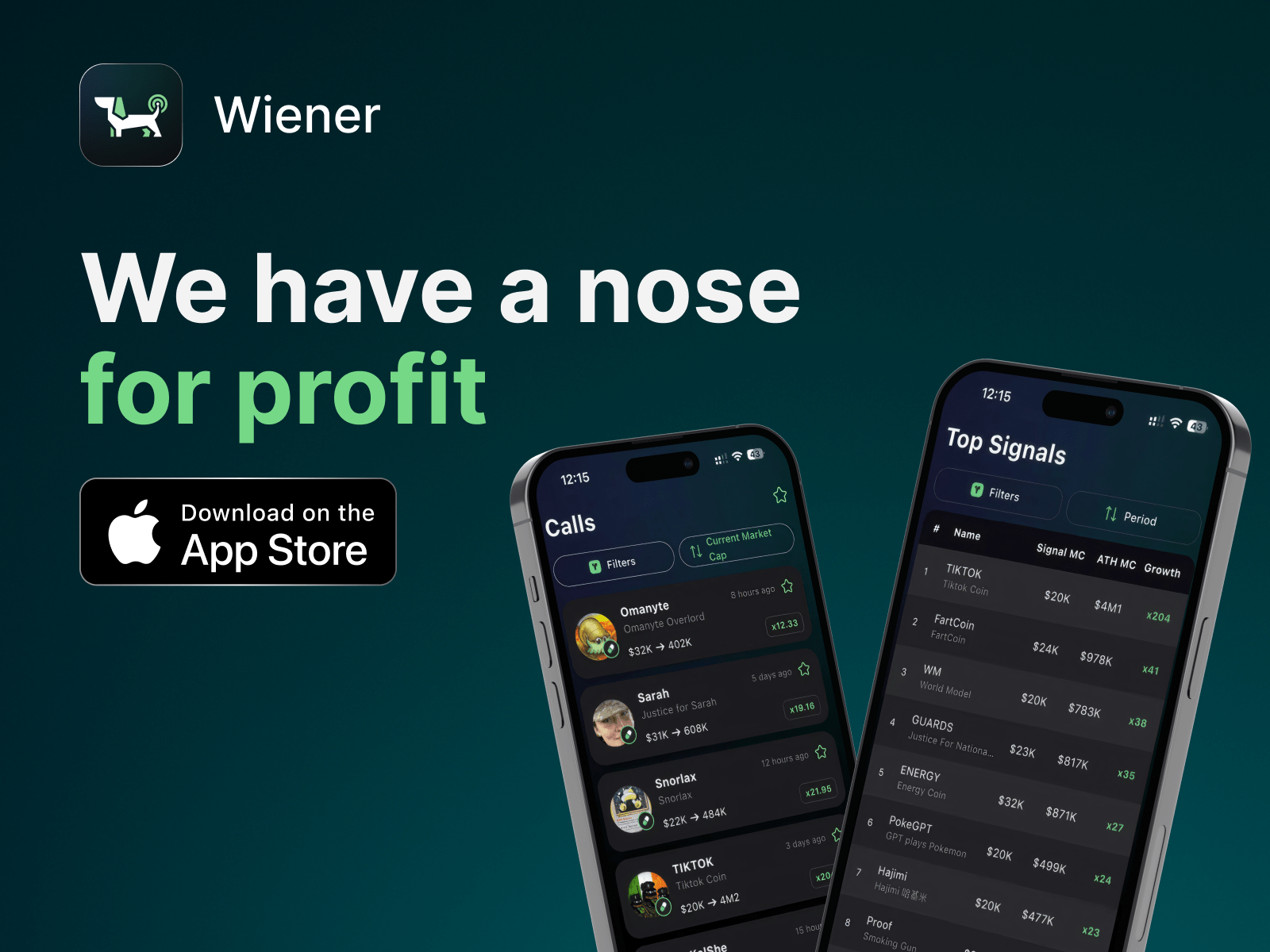
Wiener , a new mobile analytics platform for the Solana ecosystem, has launched globally on the Apple App Store. The app converts Solana’s continuous on-chain activity stream into a curated set of actionable signals designed for everyday market participants.  Solana’s low fees and high throughput have made it one of the busiest networks in the digital-asset sector. The same speed, however, generates an overwhelming volume of data. Wiener aims to make that information more accessible by filtering and ranking on-chain events in real time. This strategy presents only the developments most likely to influence market attention. “Most retail traders do not need more dashboards. They need clarity,” said Tetiana Kvashuk, creator of the Wiener app. “The goal is to surface meaningful events the moment they occur, without requiring users to sit inside terminals all day.” A Push-First Approach to Market Intelligence Wiener operates on a notification-driven model. Subscribers receive alerts on emerging tokens, unusual on-chain behaviour, wallet activity, and momentum changes across the Solana landscape. These signals come in real time. This means users can see how the market is moving without having to constantly check social media or analytics sites. Token profiles in the app give users quick looks at liquidity, ownership concentration, recent activity, and basic safety indicators. The layout is simple on purpose so that it is easy to read instead of having complicated charts. Advanced users can access modules such as Fresh Wallets, Good Traders, Bots, Whale Map, KOLs, and X Stats. These tools highlight newly active addresses, historically effective trading patterns, automated trading behaviour, large-holder movements, and social-driven shifts. Built for Simplicity, Independent by Design Although Wiener ingests large amounts of blockchain data, its interface is structured around a small set of metrics. This system is designed to allow for quick data interpretation, rather than overwhelming users. All buying and selling happens outside of the app on platforms that the user chooses. Wiener's published privacy policy says that it is not an exchange, wallet, or custodial service. To clarify: Wiener does not store or move crypto assets. This separation lets the project focus only on analytics and notification services. About Wiener Wiener is a mobile analytics app focused on real-time alerts and simplified on-chain insights for the Solana blockchain. The combination of continuous monitoring with structured filtering is at the core of this initiative. In fact, the app aims to help retail participants understand fast-moving markets without relying on complex trading tools. Wiener does not custody assets or execute trades and is not affiliated with the Solana Foundation. Wiener is free to download but requires a subscription to access any functionality. Plans - Basic Weekly, Premium, and Pro - are available through Apple’s in-app purchase system. Pricing varies by region; in the United States, subscriptions currently range from $3.99 per week to $17.99 per month depending on alert volume and feature access. Subscriptions renew automatically and can be managed through the user’s Apple ID settings. The Wiener app is now available for iPhone devices running iOS 13 or later. Anyone can find it under the name “Wiener” in the Finance category of the App Store. Further information is available on the project’s official website and on the social media pages listed below. X (Twitter) | Telegram | Instagram | Discord
By Press Release December 8, 2025
REKT, a meme token built on Solana, officially started its presale event. The project has passed three SolidProof audits and one Coinsult audit, proving that its staking and claim logic is sound. The team introduces a verified Loss Claim function, allowing traders to convert on-chain losses into $REKT. The Loss Claim Function REKT was created by a trader who lost everything, repeatedly. Instead of quitting, he built a system that turns pain into purpose. $REKT rewards what most cryptocurrencies ignore: real loss, verified on-chain. The Loss Claim feature is the main new thing about the project. The idea is to let wallets receive funds as a partial compensation for real trading losses in approved tokens. Looking at this process with a little more detail, each wallet can make one claim per month. However, such an amount can't be more than 50,000 $REKT. Also, the exact computation of the claim will depend on a so-called "portfolio multiplier". This number can grow with a) wallet age and b) staking activity, rewarding loyal holders. Strict anti-bot filters, cooldowns, and spoof protection ensure every claim is real. The Rage Claim Feature Presale tokens are auto-staked at purchase and vest linearly over six months. Early unlocks are allowed under the Rage Claim mechanism, which burns a portion of tokens based on timing: 20% in week one 15% in weeks two to three 10% in weeks four to six 5% after week six Burned amounts are redistributed: 50% to staking, 25% to treasury, and 25% to the burn wallet. Tokenomics The total supply of $REKT is fixed at 1 billion tokens. There will always be 1 billion tokens of $REKT. Fifty percent of that supply goes to the community presale, which is based on clear milestones instead of insider rounds. Another 15% is set aside for liquidity to keep the DEX stable. Also, 10% goes to the staking pool, while twenty percent goes to the treasury for growth and development. Finally, the remaining five percent goes to community projects, contests, and collaborations. There is a 1% tax on every transaction. This tax is automatically split up: 50% goes to staking rewards, 25% goes to the treasury, and 25% goes to the burn wallet. After burning 200 million $REKT, the supply reduction halts, and the tax splits evenly between staking and treasury. Roadmap The development of REKT follows a clear three-phase plan. The first stage is all about the launch and the base. Smart contracts will be put on Solana and the staking dashboard will go live. Also, SolidProof audits will check all of the systems. The second phase turns on the core logic of REKT. This includes the DEX tax system, tracking of the leaderboard, and the release of Loss Claim v2. This upgrade will come with better wallet multipliers and on-chain filters. The third phase centers on scaling and community growth. At this point, the team will launch NFT-based staking and will work for CEX outreach. Also, the official roadmap mentions more audit rounds that will complete the cycle. This milestone will mark REKT’s full transition from meme to movement. About REKT REKT is a meme token built on Solana that rewards verified losses through a whole new feature. With multiple audits, transparent vesting, and verifiable claim logic, REKT transforms trading failure into blockchain history. REKT's smart contracts have passed three full SolidProof audits and one Coinsult audit, validating both contract safety and claim logic. The upcoming presale will allow anyone to join this upcoming project with its new features. As a major highlight, REKT has recently joined a live AMA event on Binance, sharing key updates and insights with the community. The social media pages and the project’s website are a way to keep in touch with this team and with REKT's upcoming milestones: X (Twitter) | Telegram.
By Press Release December 4, 2025
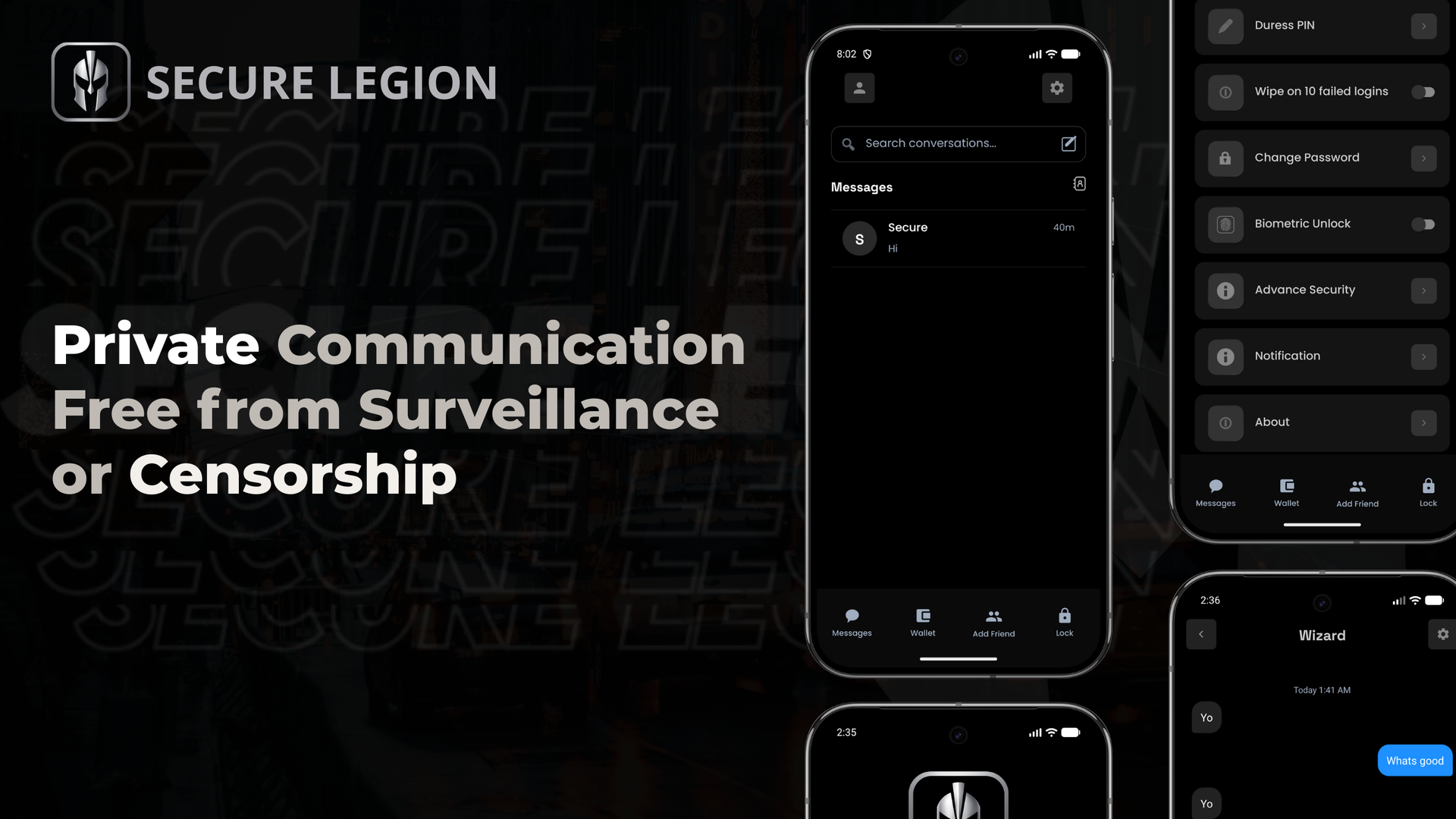
Secure Legion has announced the public beta release of the world’s first messaging application designed to expose zero metadata . Built entirely without servers, directories, or intermediaries, the platform delivers fully peer-to-peer communication through Tor hidden services ensuring that no third party can observe who is communicating, when, or from where. Unlike conventional messengers, Secure Legion replaces personal identifiers with Solana wallet keypairs , eliminating the need for phone numbers, emails, or any form of personal data. A New Standard for Private Communication Modern encrypted messengers secure message content but still leak metadata social graphs, contact networks, connection timestamps, and communication patterns. Platforms such as Signal, WhatsApp, and Telegram rely on servers that inherently retain traces of user behavior. Secure Legion removes this entire metadata surface through two core innovations: A completely serverless architecture that prevents any entity from storing, relaying, or analyzing message traffic. The Ping-Pong Wake protocol , a novel mechanism that delivers messages only when both parties are simultaneously online and authenticated. Because no server ever queues or registers communication attempts, observers cannot build relationship graphs or infer interaction frequency. Identity Through Solana Wallets Instead of traditional account systems, Secure Legion adopts a self-sovereign identity model : each user’s Solana keypair functions as their cryptographic identity across both messaging and blockchain-related interactions. This model reinforces privacy, reduces attack surfaces, and aligns with emerging ecosystem standards for decentralized identity. Engineered for High-Risk Environments Secure Legion is already being adopted by journalists, activists, and crypto communities operating in heavily restricted regions. The Android client integrates Tor bridges such as Snowflake , obfs4 , and meek , enabling reliable access in environments with deep packet inspection or aggressive censorship. Message delivery follows an authentication-before-delivery process, preventing message-waiting or mailbox-style analysis one of the key vulnerabilities of conventional encrypted messengers. As one Secure Legion engineer summarized: “Signal protects what you say. Secure Legion protects who you talk to.” With no servers, no timestamps, and no retained message queues, communication patterns become indistinguishable to observers. Open Source, Transparent, and Subpoena-Resistant Secure Legion is fully open source under the MIT license. All cryptographic components including XChaCha20-Poly1305 , Ed25519 , and X25519 ECDH are publicly documented and implemented without telemetry, analytics, or background data collection. The architecture is intentionally designed to be non-compliant with surveillance backdoors : “You can’t subpoena a server that doesn’t exist.” Key Features of the Public Beta Android client available at securelegion.org and on GitHub Fully peer-to-peer messaging via Tor hidden services StrongBox-backed encryption on supported devices Text and voice messaging Built-in Tor bridges for censorship resistance This beta release arrives amid growing global pressure on encrypted communications from the EU’s Chat Control proposal to the UK Online Safety Act and the US EARN IT Act. Secure Legion’s serverless architecture makes such mandates technically impossible to implement. Context in the Privacy Ecosystem Secure Legion responds to an issue long overlooked by mainstream encrypted platforms: metadata surveillance . Metadata exposes behavioral patterns, personal networks, movements, and relationships even when message content is encrypted. Compared to existing alternatives: - Session still relies on service nodes; Secure Legion removes intermediaries entirely. - Briar exposes certain network patterns; Secure Legion eliminates visible trails and peer graphs. - Signal reveals communication metadata to its servers; Secure Legion reveals nothing. The result is a platform that implements true metadata-free messaging by design a direction recently emphasized by leaders such as Vitalik Buterin in calls for permissionless accounts and privacy-preserving communication systems. About Secure Legion Secure Legion is a peer-to-peer, serverless messaging project developed by privacy engineers committed to eliminating metadata surveillance. The platform is non-commercial, open source, and designed around censorship resistance and cryptographic transparency. A formal security audit is underway. Upcoming roadmap items include group messaging, expanded privacy modes, and a desktop client. Follow the project and join the community: Official website | X (Twitter) | GitHub 
Show More
paper_plane

NEVER MISS AN ARTICLE!

Sign up and stay up-to-date about what's happening at our site.