Potion Review: Protocol based on Kelly Criterion for Risk Management, and Potion NFT Unlock Game to release

Wayne Jones • February 21, 2022

Potion Protocol is a web3 dApp that assists in creating automated insurance marketplaces in which buyers and sellers meet and trade at mathematically sustainable prices. How it works is you can buy Potion insurance on the price of, for example, Ethereum, locking a specific price. If the price of Eth falls below that price, the insurance will pay out.


In Potion Protocol, you may also take the opposite side and sell risk insurance (be an LP). As an LP using Potion Protocol, you may use the Kelly Criterion to trade at optimal premium and utilization combinations at all times. Hence, this results in a mathematical expectation of long-term sustainable risk management markets.


Potion Protocol's goal is to make DeFi adoption easier by offering Automated Risk Management on-chain. As a result, the crypto market becomes more secure, with risk products that are safe and sustainable for buyers and sellers.


Moreover, Potion Unlock is a novel paradigm for aggressive decentralization. It establishes a sustainable model for developers of DeFi innovations to focus on software development, as opposed to compliance rabbit holes. Engineering and design of the protocol is separated from deployment and maintenance. With the development of the Potion suite completed, Potion Unlock puts the audited project in the hands of the community.


What Potion Holds?

Potion Analytics

Potion Labs set up a specialized data-science lab to put the Kelly Machine through its paces. Potion Analytics is a set of tools that allow for self-service, no-code back-testing of the Kelly Optimal bonding curves.


The first one is the Kelly Academy that allows users to familiarize with Kelly Criterion in general. It has simple coin toss examples for this purpose

Then, there is the Kelly Optimal Premiums which are the extension of Kello Criterion into the realm of pricing. Kelly vs Black-Sholes is another one. It is a benchmark comparison of Kelly vs BSM .


Next, we have the curve designer is an easy to use custom curve creator with multi-market backtesting. Lastly, we have the Multi-asset pools that allows for the testing of single-curve multi-asset pools.


Potion Unlock

Potion NFT Unlock is a game that encourages the Potion community to work together to release the Potion Protocol into the public domain. With this one-of-a-kind strategy based on “aggressive decentralization” from the start, Potion Labs seeks to avoid the dangers of a traditional project launch, such as a small number of users wielding significant power over a protocol.


Potion Labs has taken the complete Potion protocol coding for risk management of crypto-assets, Potion Analytics and supporting documentation as an encrypted file, to be deposited into IPFS. Following that, they split its password into thousands of pieces and generate private keys which are provided to the Potion NFT minters who can acquire them through a private sale, a public NFT auction, or via airdrops being          performed to OG community members.


Kelly Criterion

The Kelly Criterion is a systematic risk allocation approach utilized by some of the world's most significant risk practitioners. It provides a mathematical framework for making optimal capital allocation decisions in the face of uncertainty.


It is especially significant in this context since it is optimized for survival and growth through repetitive, continuous risk exposure instead of opportunistic single event risk-taking. It is the exact situation the project is aiming for: LPs in an AMM constantly selling risk contracts to achieve steady long-term returns.


The Kelly Machine

The Kelly Machine is a groundbreakingDeFi system. It enables LPs and users to trade collateralized risk contracts, including insurance, puts, calls, and potentially even more complicated derivative products. It accomplishes this using a long-term mathematical expectation of capital growth due to built-in risk management that is automatically applied to all trades.


The premiums for these risk smart contracts are generated analytically from Kelly Criterion optimals. They may then be generalized to apply to any utilization-based pricing scheme.

Key features


●      Optimized for long-term capital preservation and growth throughout all market conditions: programmed to thrive in even the most volatile settings, such as crypto markets.

●      Capital efficiency: Capital may be exposed to numerous risks simultaneously. It allows LPs to achieve better utilization levels and purchasers access a more comprehensive range of goods in deeper markets.

●      Passive experience: LPs do not need to watch their positions continually. Bonding curves alter pricing dynamically to compensate for the risk.

●      Broad product selection: Capital may be used to underwrite a wide range of product configurations, with many distinct combinations of a strike price, term, asset, and so on.


Kelly Machine Vs Black-Scholes

●      Significantly less risky than Black-Scholes. There were discrepancies of up to 100% favour Kelly pricing, particularly for crypto assets.

●      The maximum draw-down is lower than in Black-Scholes. In many situations, Potion Protocol achieved median max drawdowns below 30%.

●      The long-term Alpha expectation is positive as a result of Kelly Optimal implementation.

●      Simple experience for LPs and users, making the Potion protocol accessible to everyone, not just the wealthy.

●      Allows the formation of a market equilibriumcentered on Kelly Optimal pricing.


Potion Lab’s NFT-based Business Model

Potion Labs' business model is a hybrid of many emerging approaches being tested in web3. They want to generate an income by selling Potion NFTs, with pieces of password to decrypt the Protocol, and commemorating the launches of their R&D. As a result, they will produce profits that will support operational expenditures, pay off debts, and keep them working on fascinating DeFi research.


There are six types of Potion NFTs or "rarities”, the more decryption power they have and the less redundancy the better. The first is the Fellowship NFT, the most common NFT (2,600 units auctioned) which provides 6.64% percent decryption power with a redundancy of 100. Advanced NFTs (1,800 units) have a decryption power of 13.13% and a redundancy of 40, so users will have more clout than Fellowship NFT holders.


Legendary NFTs have a decryption power of 17.51% and a redundancy of 25. Potion is only auctioning 750 of these NFTs, but owning them provides users with legendary status over other players.


Original Gangsters (OGs) NFTs (2,850 units) are assigned to their founding members and have a decryption power of 12.77% with a redundancy of 114. Following that, Kelly Knight NFTs (522 units) were made available at Potion's private sale. These NFTs have a decryption power of 9.52 percent and redundancy of 2, implying that Kelly Knights holders will have a significant power.


Lastly, the Wise Wizard NFTs (1,478 units) were also offered during our private sale to key DeFiplayers, and hold a decryption power of 40.43% with a redundancy of 2 as well, also giving their holders significant decryption capability.


The public sale of Potion NFTs is happening imminently. Whitelisting is live, and the Dutch-style auction will be from 28th to 7th March for the Fellowship, Advanced and Legendary Potion NFTs. Book the dates, they’re making history! After the public sale, the Potion NFT Unlock game should start for players to collaborate on-chain to bring enough pieces of password together and decrypt the protocol’s codebase and release it to the public domain.


Potion's Future Goals

Potion Labs' first purpose is to provide a faultless NFT minting experience, while also having fun hosting the Potion Unlock game. It is a novel, revolutionary release method, and the team is eager to give the most excellent possible experience for everyone who contributes to the Potion Unlock open-ended game to potentially decrypt the Potion protocol and release it to the public domain with a sustainable business model for Potion Labs.


On the product front, they are thrilled about expiration-free, pay-as-you-go insurance and automated curve management, two enormous boulders for which they have great ideas and that are a natural next step for this initial release. Long term, Potion Labs dreams about an automatic tail risk hedger for asset portfolios, where one may keep their holdings in a black swan-secure way for a long time.


Final Thoughts

Beyond Potion Labs and its initial specific insurance application, the team feels it is beneficial to think and develop more trustless financial applications like the Potion Protocol. Cooperation among societal actors, like that of the Potion Unlock game to release the protocol’s codebase to the public domain, can yield enormous benefit from this dApp. The long-term effect potential for the development of public goods with a sound business model like that of Potion Labs is substantial.


Disclaimer: This is not trading or investment advice. The above article is for entertainment and education purposes only. None of the content on Crypto Folds is investment advice nor is it a replacement for advice from a certified financial planner. Please do your own research before purchasing or investing into any cryptocurrency.  
By Press Release December 4, 2025
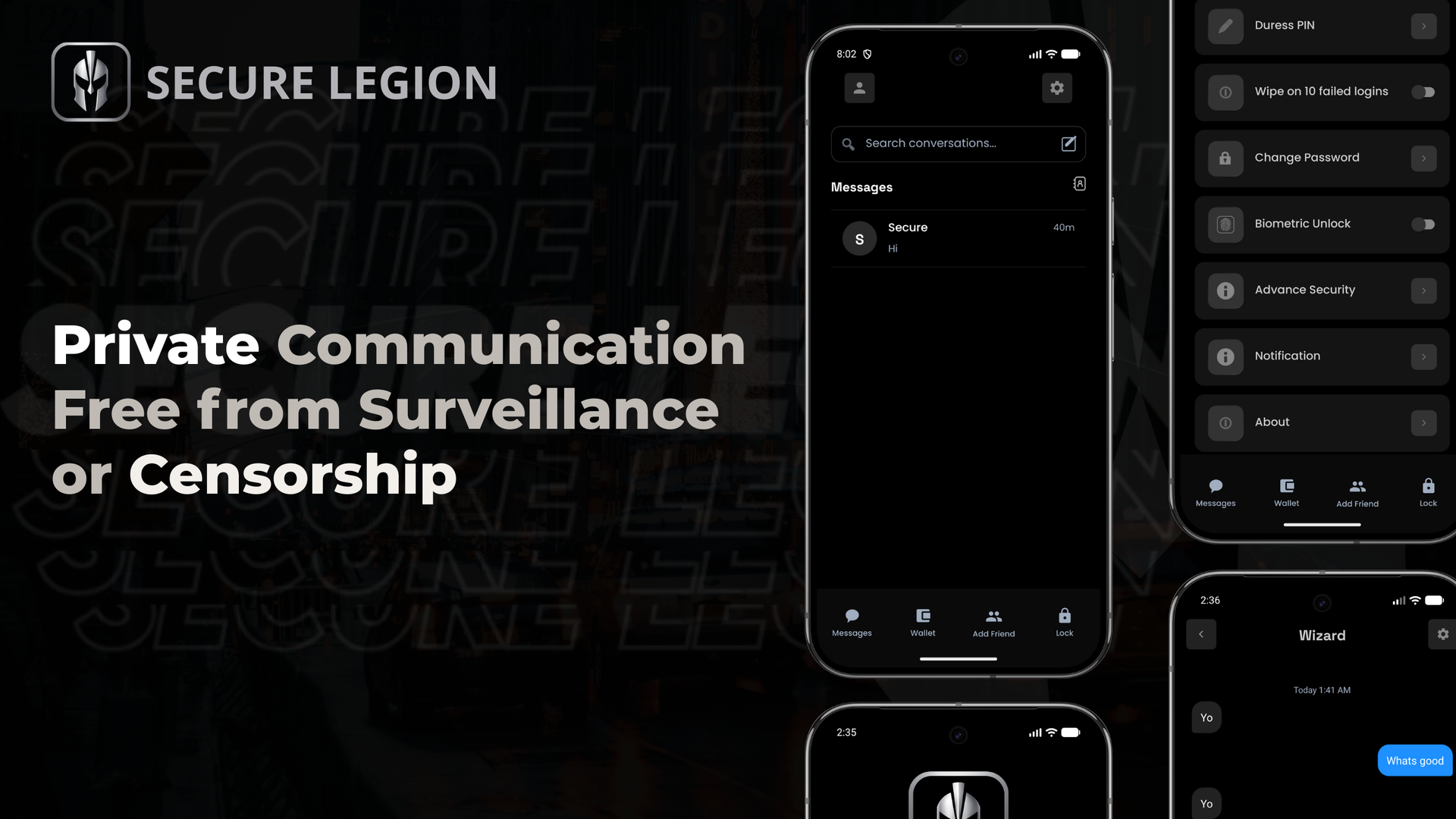
Secure Legion has announced the public beta release of the world’s first messaging application designed to expose zero metadata . Built entirely without servers, directories, or intermediaries, the platform delivers fully peer-to-peer communication through Tor hidden services ensuring that no third party can observe who is communicating, when, or from where. Unlike conventional messengers, Secure Legion replaces personal identifiers with Solana wallet keypairs , eliminating the need for phone numbers, emails, or any form of personal data. A New Standard for Private Communication Modern encrypted messengers secure message content but still leak metadata social graphs, contact networks, connection timestamps, and communication patterns. Platforms such as Signal, WhatsApp, and Telegram rely on servers that inherently retain traces of user behavior. Secure Legion removes this entire metadata surface through two core innovations: A completely serverless architecture that prevents any entity from storing, relaying, or analyzing message traffic. The Ping-Pong Wake protocol , a novel mechanism that delivers messages only when both parties are simultaneously online and authenticated. Because no server ever queues or registers communication attempts, observers cannot build relationship graphs or infer interaction frequency. Identity Through Solana Wallets Instead of traditional account systems, Secure Legion adopts a self-sovereign identity model : each user’s Solana keypair functions as their cryptographic identity across both messaging and blockchain-related interactions. This model reinforces privacy, reduces attack surfaces, and aligns with emerging ecosystem standards for decentralized identity. Engineered for High-Risk Environments Secure Legion is already being adopted by journalists, activists, and crypto communities operating in heavily restricted regions. The Android client integrates Tor bridges such as Snowflake , obfs4 , and meek , enabling reliable access in environments with deep packet inspection or aggressive censorship. Message delivery follows an authentication-before-delivery process, preventing message-waiting or mailbox-style analysis one of the key vulnerabilities of conventional encrypted messengers. As one Secure Legion engineer summarized: “Signal protects what you say. Secure Legion protects who you talk to.” With no servers, no timestamps, and no retained message queues, communication patterns become indistinguishable to observers. Open Source, Transparent, and Subpoena-Resistant Secure Legion is fully open source under the MIT license. All cryptographic components including XChaCha20-Poly1305 , Ed25519 , and X25519 ECDH are publicly documented and implemented without telemetry, analytics, or background data collection. The architecture is intentionally designed to be non-compliant with surveillance backdoors : “You can’t subpoena a server that doesn’t exist.” Key Features of the Public Beta Android client available at securelegion.org and on GitHub Fully peer-to-peer messaging via Tor hidden services StrongBox-backed encryption on supported devices Text and voice messaging Built-in Tor bridges for censorship resistance This beta release arrives amid growing global pressure on encrypted communications from the EU’s Chat Control proposal to the UK Online Safety Act and the US EARN IT Act. Secure Legion’s serverless architecture makes such mandates technically impossible to implement. Context in the Privacy Ecosystem Secure Legion responds to an issue long overlooked by mainstream encrypted platforms: metadata surveillance . Metadata exposes behavioral patterns, personal networks, movements, and relationships even when message content is encrypted. Compared to existing alternatives: - Session still relies on service nodes; Secure Legion removes intermediaries entirely. - Briar exposes certain network patterns; Secure Legion eliminates visible trails and peer graphs. - Signal reveals communication metadata to its servers; Secure Legion reveals nothing. The result is a platform that implements true metadata-free messaging by design a direction recently emphasized by leaders such as Vitalik Buterin in calls for permissionless accounts and privacy-preserving communication systems. About Secure Legion Secure Legion is a peer-to-peer, serverless messaging project developed by privacy engineers committed to eliminating metadata surveillance. The platform is non-commercial, open source, and designed around censorship resistance and cryptographic transparency. A formal security audit is underway. Upcoming roadmap items include group messaging, expanded privacy modes, and a desktop client. Follow the project and join the community: Official website | X (Twitter) | GitHub 
By Press Release December 1, 2025
SuperIntent , the AI-powered DeFi platform, has launched its Alpha App and Mission Airdrop Point System following a seed round that pushed its fully diluted valuation to US$25 million. As stablecoin continue to heat up and bring crypto further into the mainstream in 2025, the XY Finance team, which has been backed by industry leaders such as Circle and Lemniscap, announced its rebrand in Q2 2025 as SuperIntent, opening an early waitlist that has since attracted over 100,000 users. After piloting in APAC in September, SuperIntent is now launching globally, with over 200,000 users sign-ups to date.  Simplifying DeFi for Smarter, Accessible Yield SuperIntent aims to make DeFi investing simpler, more accessible, and even a source of passive income. As DeFi shifts from meme-driven speculation to stronger fundamentals such as sustainable buybacks, the rise of fixed-rate yield products, and more structured arbitrage and market-neutral strategies, yield opportunities are becoming richer and more stable but also more fragmented. This creates a clear need for a smarter, unified solution. “For most users, DeFi still feels like wandering without a guide. People expect the same seamless experience they get from traditional wealth management,” the team added. “With recent breakthroughs in AI, we can finally deliver a real co-pilot that understands user intent, optimizes yield, and executes safe strategies across chains with a single tap.” In its Alpha App, SuperIntent’s Earn feature unifies top protocols into a single interface with one-click rewards, so users can allocate funds in one tap and never miss their yield, including both native yield and reward tokens. Cross-Sector Investors Signal Confidence in SuperIntent’s Direction SuperIntent team has long been active in DeFi and specialized in cross-chain infrastructure. It was among the earliest supporters of Circle’s Cross-Chain Transfer Protocol (CCTP) and recently joined the Circle Alliance Program. Investor interest began to build earlier this year amid the rise of the AI narrative and growing adoption of chain abstraction technologies. Momentum increased after the rebrand and Circle’s IPO, together with clearer stablecoin regulation in key markets including the United States and Asia. In this seed round, participation came from existing backers and Web3-native funds as well as a wave of traditional finance and software investors. These developments collectively reinforced investor confidence in the sector’s long-term potential for sustainable yield products, positioning SuperIntent at the forefront of the emerging intersection between AI and DeFi. Global Expansion and the Shift Toward Steadier DeFi Investing SuperIntent App integrates multiple DeFi yield sources into a seamless user interface that helps users grow their assets steadily and avoid market volatility. While the U.S. remains a major market, strong early traction has also come from Southeast Asian countries, where many gig and informal workers have irregular income and remain underserved by traditional financial institutions. DeFi offers a viable alternative for yield generation and financial inclusion. “Simply holding assets or actively trading is no longer the only way to participate in crypto. Since the October 10 crypto crash, where many perp users were hit hard and several overly complex vault products suffered heavy losses recently, SuperIntent’s user base has grown significantly, reflecting a clear shift toward more risk-aware, stable yield-focused strategies. SuperIntent is exactly where it needs to be, helping users put their idle crypto to work through a more sustainable and stable approach.” Looking ahead, SuperIntent plans to expand protocol coverage, roll out an AI-driven personalized yield sniper notification, and add automated features such as auto-rebalancing and DCA (Dollar-Cost Averaging) to deliver a more end-to-end investment experience and help users grow their assets automatically. By combining AI-driven intelligence with a user-centric design, SuperIntent aims to redefine how people interact with DeFi, turning complexity into simplicity and making intelligent investing accessible to everyone. About SuperIntent SuperIntent is a crypto AI app that simplifies on-chain earning strategies. Built on a multi-agent framework with rich yield sources, SuperIntent helps users discover alpha, manage risk, and grow their assets with ease. SuperIntent App SuperIntent Mission Point System Official Website SuperIntent Social Media
By Press Release November 28, 2025
CDG Project has announced that its ERC-20 utility token, CDG, will be listed on BitMart Exchange beginning December 1st. The listing marks the project’s first entry into major centralized markets following its recent appearance on CoinMarketCap and CoinGecko.  The CDG token powers a decentralized network built from user-owned hardware devices that function as a distributed data center. This is an important feature for AI, cloud, VPN, gaming, and edge workloads. Thousands of CDG Devices operate as a resource layer. In short, the devices supply computation and bandwidth while earning CDG from the network’s emission treasury. Token Utility and Network Economics CDG is an ERC-20 utility token that powers the device network. Every day, device owners make CDG. Businesses can use the network for AI inference, cloud microservices, gaming workloads, and encrypted VPN routing. The token economy is based on long-term sustainability, fixed emissions, and usefulness in the real world. Integration with Codego’s IBAN and card infrastructure provides an additional layer for future payment and service models. Here are the key token metrics: Total supply: 10,000,000,000 CDG Standard: ERC-20 (18 decimals) Type: Utility token Emission: 200 CDG per active device per day Furthermore, here is more information in terms of token distribution: 70% Treasury 5% Team 5% Marketing 5% Operations 5-10% Liquidity & Partners A Decentralized Datacenter Powered by Consumer Hardware The project introduces a hardware ecosystem where each device contributes GPU and compute resources to the CDG network. In return, every active device receives a daily allocation of CDG, forming a predictable and transparent emission model. Two devices form the core of the network: CDG Power Home and CDG Home. The first has the following features: Daily Get CDG: 200 CDG Device price: €10,000 Activation cost: 40,000 CDG Power consumption: 30W CDG Home can be summarized by the following points: Daily Get CDG: 50 CDG Device price: €2,500 Activation cost: 10,000 CDG Power consumption: 10W Both devices are designed for low energy use and quiet operation. This mechanism allows homes and offices to participate in the network without technical setup. About CDG CDG is an ERC-20 utility token designed to power a decentralized data center formed by user-operated CDG Devices. Codego Group is working on the project. This team aims to offer scalable compute, cloud, and network services through a distributed hardware layer that everyday people own. The BitMart listing makes the CDG ecosystem more accessible, meaning more people can take part in the device-powered datacenter model. The network keeps getting bigger as more devices are turned on and added to the global infrastructure. The project’s official website and the links below allow anyone to join this project at its current stage. CoinMarketCap | CoinGecko
By Press Release November 21, 2025
HelloTrade, a new blockchain-powered trading platform founded by former BlackRock crypto directors Wyatt Raich and Kevin Tang, announced that it has closed a $4.6M seed round led by Dragonfly Capital. The round came together in under a week, reflecting strong conviction in the size of the market opportunity and the team’s track record building category-defining products. At BlackRock, Kevin and Wyatt launched the firm’s spot Bitcoin ETF, the fastest ETF in history to reach $100B in assets. For decades, access to the world’s capital markets and leveraged equity trading has been constrained by geography, high capital requirements, complex derivatives, and legacy brokerage systems. These barriers have made obtaining directional exposure and leverage to global equities challenging for retail and professional investors. HelloTrade aims to change that. Built on MegaETH, the platform will let users everywhere gain leveraged exposure to stocks, ETFs, commodities, and crypto. The app is designed for everyday investors with a mobile first experience, removing the usual points of friction that come with crypto trading. There is no wallet setup, no gas payments, and no technical jargon. Users simply open the app and trade with the speed of a traditional brokerage platform, enabled by MegaETH’s ability to process more than one hundred thousand transactions per second. “Trading stocks with leverage shouldn’t be gated by geography or account minimums,” said co-founder Kevin Tang. “We’ve now seen how crypto derivatives transformed access to digital assets. HelloTrade applies that same ethos to traditional equities, making it possible for investors around the world to participate in the world’s most dynamic markets”. The company is supported by a strong group of advisors, including Arthur Hayes (Maelstrom), Josh Lim (FalconX), David C. (LeadBlock Partners & LeadBlock Bitpanda Ventures), Larry Florio (Ethena), and Andrew Saunders (Amazon). “While leading the engineering team for BlackRock’s Digital Assets Lab, I had the privilege of building IBIT, ETHA, and BUIDL, some of the largest cryptoasset products in the world. That experience highlighted a tremendous opportunity to bring the same trust, discipline, and institutional standards we upheld at BlackRock to the rest of the world and build something truly transformative with HelloTrade,” said co-founder Wyatt Raich, and prior head of digital assets engineering at BlackRock. Kevin and Wyatt first crossed paths at BlackRock as foundational team members in the firm’s digital assets division. Despite their different backgrounds-Kevin as a financial services veteran with over 12-years experience, and Wyatt coming from a career in AI and robotics at Lockheed Martin-the two shared a conviction that blockchain technology could transform capital markets and investing. HelloTrade is expected to launch in the form of a mobile app across both iOS and Android. For early access, a waitlist is currently live at hello.trade . For press inquiries, please contact: Press Contact: press@hello.trade 
Show More
paper_plane

NEVER MISS AN ARTICLE!

Sign up and stay up-to-date about what's happening at our site.